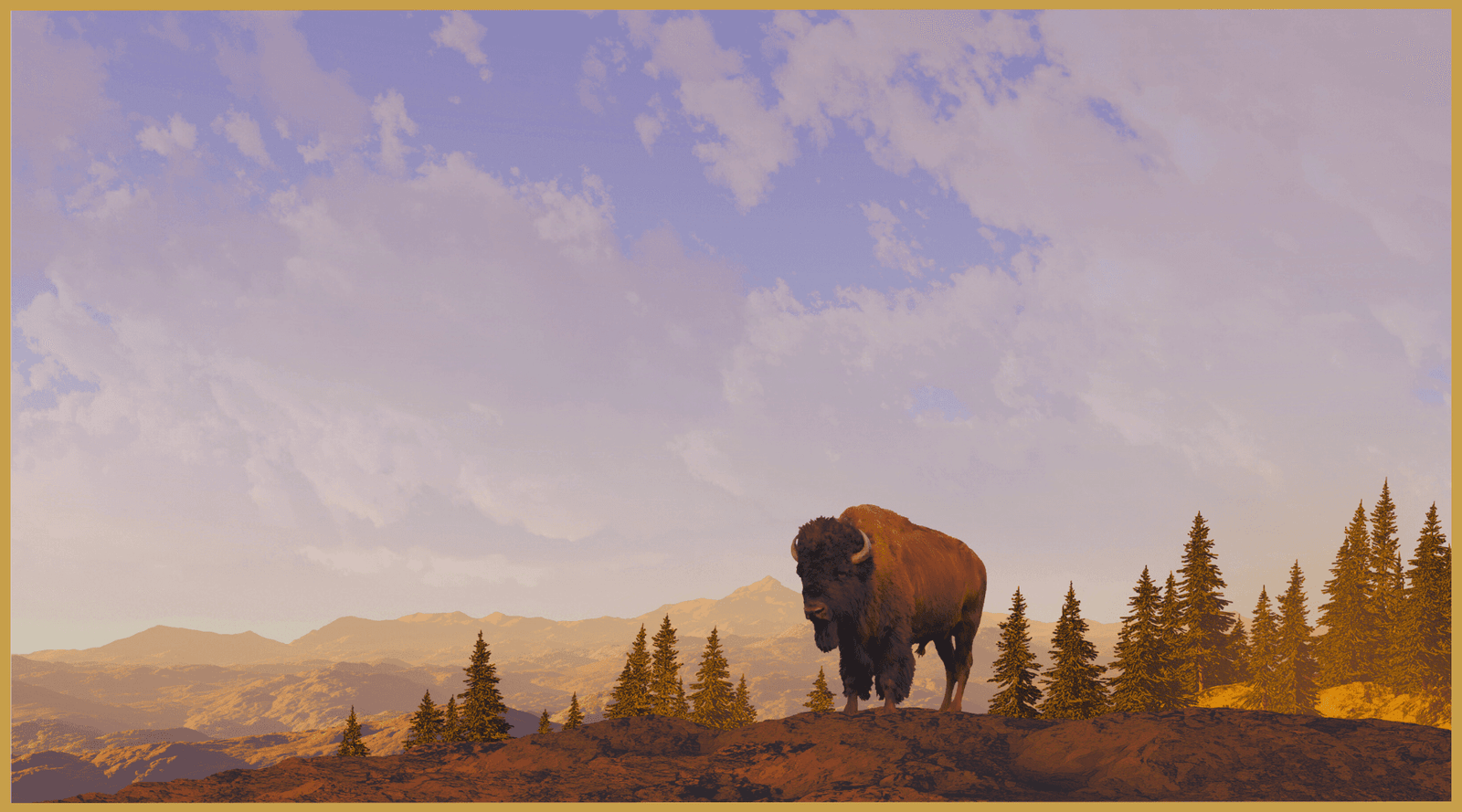

Illustration by designwest via Canva.
“It’s deeply healing not to imagine what times were like — our ancestors’ relationship with [bison] — but to see it. That’s incredibly healing.” — Tiffany Pyette, a Cherokee descendant and founder/co-executive director of the Appalachian Rekindling Project
Many people believe wild bison have only ever lived in Yellowstone National Park or the vast open spaces depicted in Western films. Yet, Native and archaeological records indicate that bison were found in nearly every part of the United States (sorry, Aloha State), including Appalachia.
Now, this legendary animal may be coming back to our mountains.
In Letcher County, Kentucky, an Indigenous, women-led group is trying to reintroduce bison on 63 acres of a reclaimed mountaintop removal coal mine.
“Eastern Kentucky is a place where bison were native to, but they were removed at the same time that many of our people were removed,” says Tiffany Pyette, a Cherokee descendant and founder/executive director of the Appalachian Rekindling Project (ARP).
The disappearance of bison from Appalachia and overall species decline over the centuries is inextricably tied to the forced removal and genocide of Native people in the U.S.
“As westward expansion was happening, that is when we saw bison really kind of retreat to the Great Plains,” said Rosalyn LaPier, a University of Illinois professor and Indigenous writer, environmental historian, and ethnobotanist.
Overharvesting, territory loss, and increased farming by European settlers led to the species’ decline and eradication from the Eastern U.S. wilderness.
Today, LaPier said, “Indigenous communities are working to rebuild, and working to revitalize some of their cultural practices,” adding that this involves their relationship to the natural world including bison.
ALSO FROM KENTUCKY

Every purchase helps keep our Appalachian magazine alive, thriving, and free to readers like you.
A common misconception or stereotype is that Native populations only lived in the natural world as it existed. However, they played an active role in shaping their environment, including conducting controlled burns and transplanting plants.
To help bison flourish, Native people practiced habitat enrichment, maximizing the types of grasses these animals ate. Historically, Native people didn’t have to hunt for bison, explained LaPier, “they know exactly where they’re going to be because they’ve created pastures for them to go and eat.”
BISON ARE NATURE'S 'ECOSYSTEM ENGINEERS.'
Since the 1990s, some Tribal nations in the Great Plains have been working to revitalize their relationship with bison, and their experience can provide direction for those beginning this work. Pyette and her ARP co-executive director, Taysha DeVaughan, have visited herds on the Wind River Reservation in Wyoming and The Nature Conservancy’s Nachusa Grasslands in Illinois.
The group’s goal is to reintroduce four bison on the land this summer. “Ideally, for one bison, you should have about 20 acres,” Pyette says. “So, with our 63 [acres], we’re pushing it.”
Pyette refers to bison as “ecosystem engineers.” They offer numerous benefits to this parcel, which was badly damaged by mountain-top removal. The animal’s hooves will till the soil, and their fur will carry and disperse seeds.
Yet for all its value, the effort is more complex than it might seem. “It’s not just, ‘Let’s put some bison on a sterile piece of land that’s been disturbed, and wonderful things will happen,” explained LaPier.
ARP’s herd will rotationally graze, and the organization will plant native grasses and plants for both the animals and ecological improvements to the land. Some include aronia, persimmon, plum, Kentucky coffee tree, spicebush, bundleflower, false indigo, hazel and senna. The bisons’ diet will be supplemented with hay, which will be grown on land ARP owns in Virginia.
After testing the mining site’s water and plants, ARP determined that while the plants are safe for consumption, the water is not — it contains high levels of aluminum. For the first three years, ARP will truck in clean water for the bison, while the team works to create healthier water conditions on the property.
“We want them to be as wild as possible,” Pyette said.
FROM THE EARTH





Every purchase helps keep our Appalachian magazine alive, thriving, and free to readers like you.
THE LAND DESERVES BETTER THAN A FEDERAL PRISON.
Not so coincidentally, ARP’s property falls within the designated boundaries of the proposed construction site for a 1,408-bed federal prison. The organization acquired the land with support from the grassroots coalition Building Community Not Prisons.
“We have other plans for this land, because our community deserves better, the land deserves better, and we have Indigenous knowledge on how to fix what was wrong,” Pyette shared on a January 2026 webinar.
The Federal Bureau of Prisons still intends to move forward with the proposed prison, and U.S. Rep. Harold “Hal” Rogers of Kentucky recently applauded the inclusion of $610 million for construction funding in the 2026 federal funding package. But Pyette claims the agency won’t be able to build using its original blueprint because ARP doesn’t intend to sell its land if it’s approached.
Pyette acknowledges that the bison herd won’t offer as many jobs as a federal prison, but it could create other unique economic opportunities. “We want Appalachian artisans to be able to spin down [bison] wool and sell it or use it in their projects,” Pyette said. Bison meat could be sold after cultural harvests alongside other products made from bison.
The organization may also issue deer hunting permits for the land to control that species’ population. Plus, as the bison breed and the herd grows naturally, Pyette hopes to share bison with other Native-led organizations looking to reintroduce bison in the future.
Ultimately, Pyette says, “bison are a “truly sacred animal” for Indigenous populations.
“It’s deeply healing not to imagine what times were like — our ancestors’ relationship with [bison],” Pyette said, “but to see it. That’s incredibly healing.”
The longer, original version of this story is found in The Appalachian Voice.
A digital storyteller from East Tennessee native, Abby Hassler is managing editor of the Appalachian Voice. She also worked in communications for a decade, focused on clean energy, clean tech and economic development. She holds two undergraduate degrees in journalism and teaching English as a second language.
5 WILDFLOWER HIKES
NEXT UP