



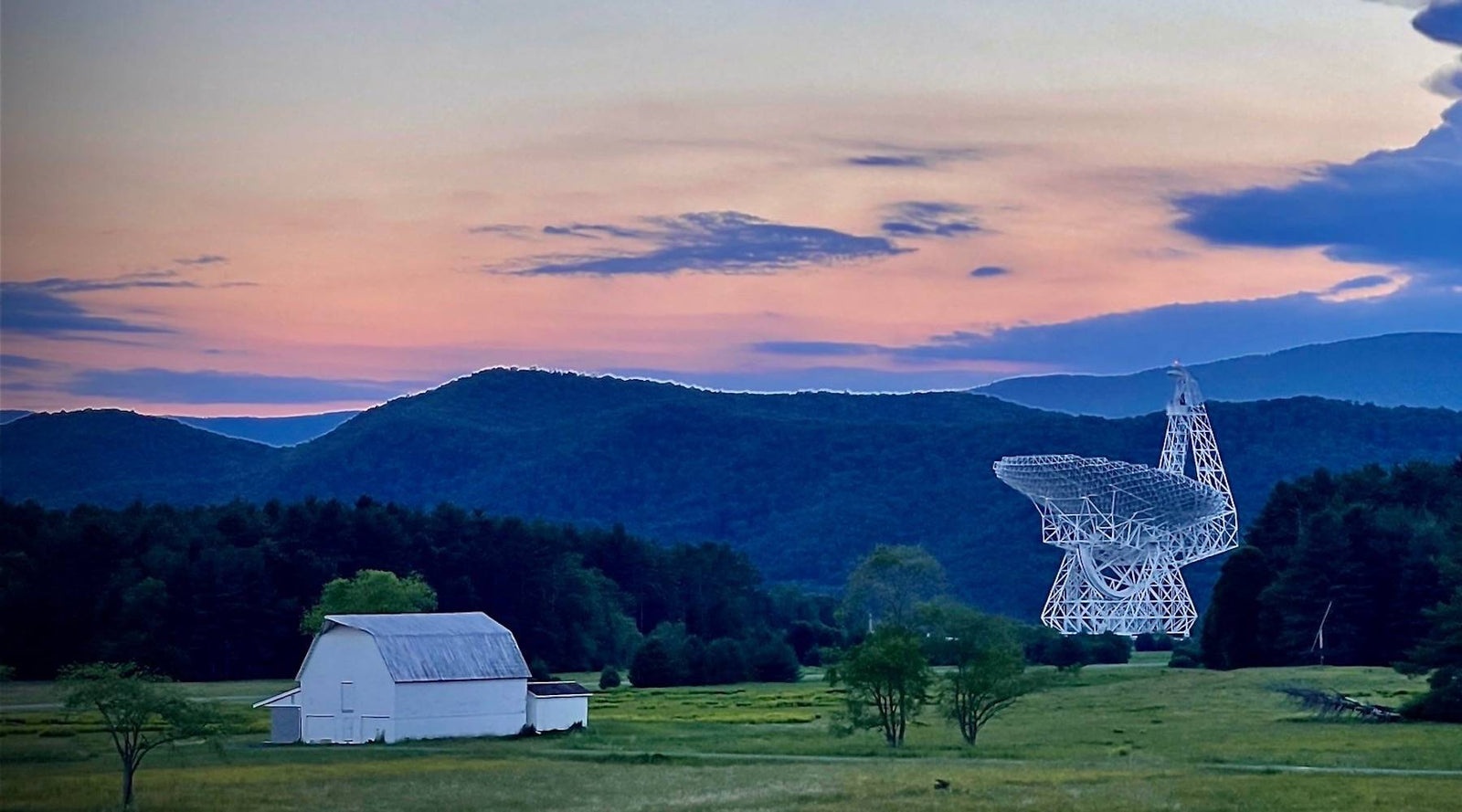

WEST VIRGINIA'S Green Bank TELESCOPE REACHES NEARLY AS HIGH AS adjacent MOUNTAINS AS IT LISTENS FOR SIGNS OF LIFE BEYOND EARTH. Photo courtesy of National science foundation's Green Bank Observatory and photographer jill Malusky.
In a quiet West Virginia valley, a giant radio telescope searches for signs that we’re not alone in the universe.
At Green Bank Observatory in Green Bank, West Virginia, scientists are tackling some big questions: How do stars form? What is happening in distant galaxies? Is anybody else out there?
Big questions like these call for a big eye on the sky, and the Green Bank Telescope fits the bill. Standing more than 485 feet tall, with a dish roughly the size of two football fields, it’s the world’s largest, fully-steerable radio telescope. That means it can turn and tilt to observe different parts of the sky.
“It’s hard to picture just how big it is without standing in its shadow,” said Will Armentrout, an astronomer at the observatory. That shadow can extend nearly a fifth of a mile.
Though we often describe radio astronomy as “listening” to space, this giant dish actually collects radio waves, a form of light invisible to our eyes, and focuses them toward sensitive receivers. Will compares it to catching rain: A bucket collects more water than a cup, and a larger telescope collects more light, helping scientists detect faint objects farther away.
WONDERFULLY WEIRD IN APPALACHIA












Every purchase helps keep our Appalachian magazine alive, thriving, and free to readers like you.
For Will, the telescope offers a closer look at baby stars and the clouds of gas where they’re born, helping him understand how stars like our sun get their start. Other researchers have used it to discover that Mercury’s core is partly molten and find evidence of gravitational waves, ripples in space and time.
But stars, planets, and cosmic ripples aren’t the only things worth tuning in for. Researchers at Green Bank also use radio waves to search for signs of intelligent life beyond Earth. (Yes, we’re talking about aliens.)
The theory is that another civilization might use radio waves to communicate, much as we do. A transmission resembling our own could qualify as a “technosignature,” or evidence of technology beyond Earth.
Unfortunately, no extraterrestrial hellos have come through just yet. But that doesn’t mean researchers will stop listening.
ALSO FROM WEST VIRGINIA








Every purchase helps keep our Appalachian magazine alive, thriving, and free to readers like you.
Part of what makes that listening possible is the National Radio Quiet Zone. Within this roughly 13,000-square-mile area, companies planning cellphone towers, broadcast stations, and other fixed transmitters must work with the observatory to limit interference.
A separate West Virginia law restricts everyday electronics like cordless phones and microwave ovens closer to the telescopes. Those protections do however leave some room for modern life: Although Wi-Fi was long restricted, the observatory now allows certain 2.4 GHz networks.
Together, these measures help keep signals from Earth from drowning out the ones scientists want to study. And somewhere in that cosmic quiet, researchers hope to find a transmission that changes our understanding of who else might be out there — “evidence,” Will said, “for an advanced civilization.”
STELLAR PLACES TO STARGAZE
NEXT UP